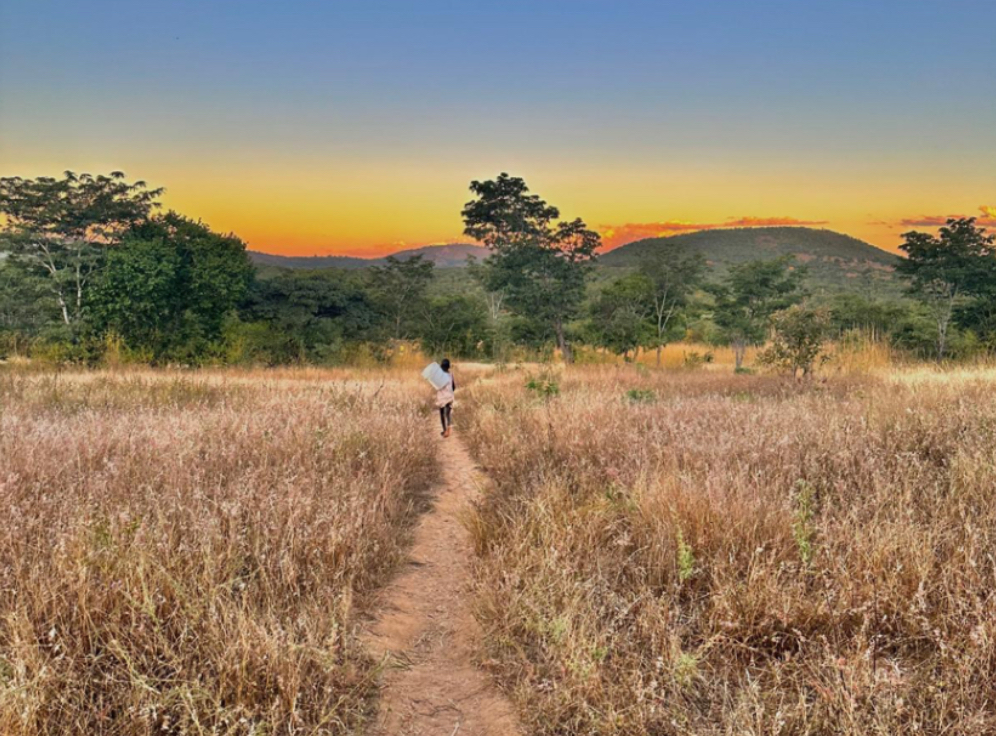
Let’s say you travel from one of the richest countries in the world. You take 3 flights and land more than thirty hours later at Harare International Airport. Then you head out on an increasingly pockmarked tarmac for two hours, turn on a washboard dirt road, and drive another hour. Next you turn off into a field, the tires of your vehicle straddling a trail through tall, head-high grass. For ten minutes, the savannah slaps and gives way outside your window, until you pull up to a circular structure, about ten feet in diameter, with a thatched grass roof.
What will you find there?
There, on the ragged fringes of the world, you will discover what happens when the father of three daughters, ages sixteen, ten, and eight, dies in rural Zimbabwe. And when the girls’ mother, in desperation, abandons her children.
Perhaps that first night, the oldest, *Nancy, wiped the tears of the younger girls and settled them around the campfire burning in a hole in the cement floor of their home. Maybe she leaned back against the brick wall, too stunned to cry herself, watching the smoke billow up to the thatched grass roof, listening to the crickets and rustling of tall grasses, the emptiness, around them. Perhaps she tried not to think about the animals or humans that could barge through the door, hanging crooked and unsecured.
Of course, as the days wore on, Nancy dropped out of school. What other choice could she make? Due to the poverty of the surrounding community, she had nowhere to turn for help. Although semis brimming with natural resources like diamonds, platinum, and gold stream from Harare to ports in Mozambique, the revenue will never reach the pockets of the majority of the people in the capital city, much less the rural edges of the country. And even less, the 7 million orphaned children, representing 7.7% of Zimbabwe’s population.
Somehow, Nancy managed to keep the young family alive. But they slept on the cement floor, huddled together for warmth; weather wore holes through the roof; termites nested in the exterior walls; food ran scarce; and the grass grew wild and untamed, a haven for wild creatures.
But then, thank God, a van passed nearby, labeled Heather Chimhoga Orphan Center (HCOC) with an address emblazoned across the door. Nancy found her way to the central offices, and despite her need for so much, her only request that day: to attend school again.
Soon after, a local woman, elected by the village and commissioned by HCOC to provide oversight of orphaned children in the community, visited to assess.
And the wheels of God’s passion for vulnerable kids began to roll through the people on earth who love Him.
Nancy returned to school and HCOC began to provide regular food packets. A social worker checks on the girls often, despite an encounter during one visit with a Black Mamba, one of the deadliest snakes in the world. When it reared its narrow neck flaps, he vaulted from his motorbike, thrusting it over the snake. Although injured from the fall, he escaped a bite that would have caused collapse within 45 minutes and death within 7-15 hours.
On the day I visited, HCOC staff and volunteers discussed plans to provide beds for the girls and to rally the community to make much-needed repairs to the home, including the installation of a sturdy door and cutting back overgrown grass.
Slowly but surely, hope creeps into the hearts of a 16-year-old girl and her sisters, left in a desperate situation.
However, I am left ragged. Haunted by the image of driving away from Nancy as she stood in the doorframe, watching us leave, her face hidden under the roof of what is left of her former family home.
I know that God’s Kingdom extends even there. I know, because God promises that He is the defender of the defenseless, Father to the fatherless. I reminded Him of this when we circled the fire in the middle of the rondavel that day in prayer before we left. I begged Him to stand guard around those girls, to protect them through the dark watches of the night.
And I know because in some ways, time stopped that day for me. My mind and soul keep circling back again and again, trying to make sense of a living nightmare.
I’m not sure yet what happens when you travel from one of the richest countries to the outer fringes of the world, when you witness a situation like this. For now, I only know that I am deeply disturbed. And I can’t unsee what I saw.
In my work as Director of Orphan Care with Hope’s Promise, we eagerly network and collaborate with other global orphan care organizations. I was heartbroken but privileged to visit two child headed households served by the Heather Chimhoga Orphan Center, established in partnership with the CO based Zimbabwe Mission Partnership (ZMP), with ZMP board member, Deanna Heyn, in May 2025.
 Colleen Briggs Images & Writing
What a tragic, beautifully expressed, hopeful and yet devastating piece. It’s impossible to describe the impact this had on me. Thank you.
I couldn’t read this without a tear. Having been there has an impact for sure, but you are an amazing writer and I love reading everything you write. Even the heartbreaking stuff like this. Hope’s Promise is an amazing place to work, but more importantly, they change the lives of so many children. Prayers for blessings over HCOC also. Thanks for sharing this, Colleen.