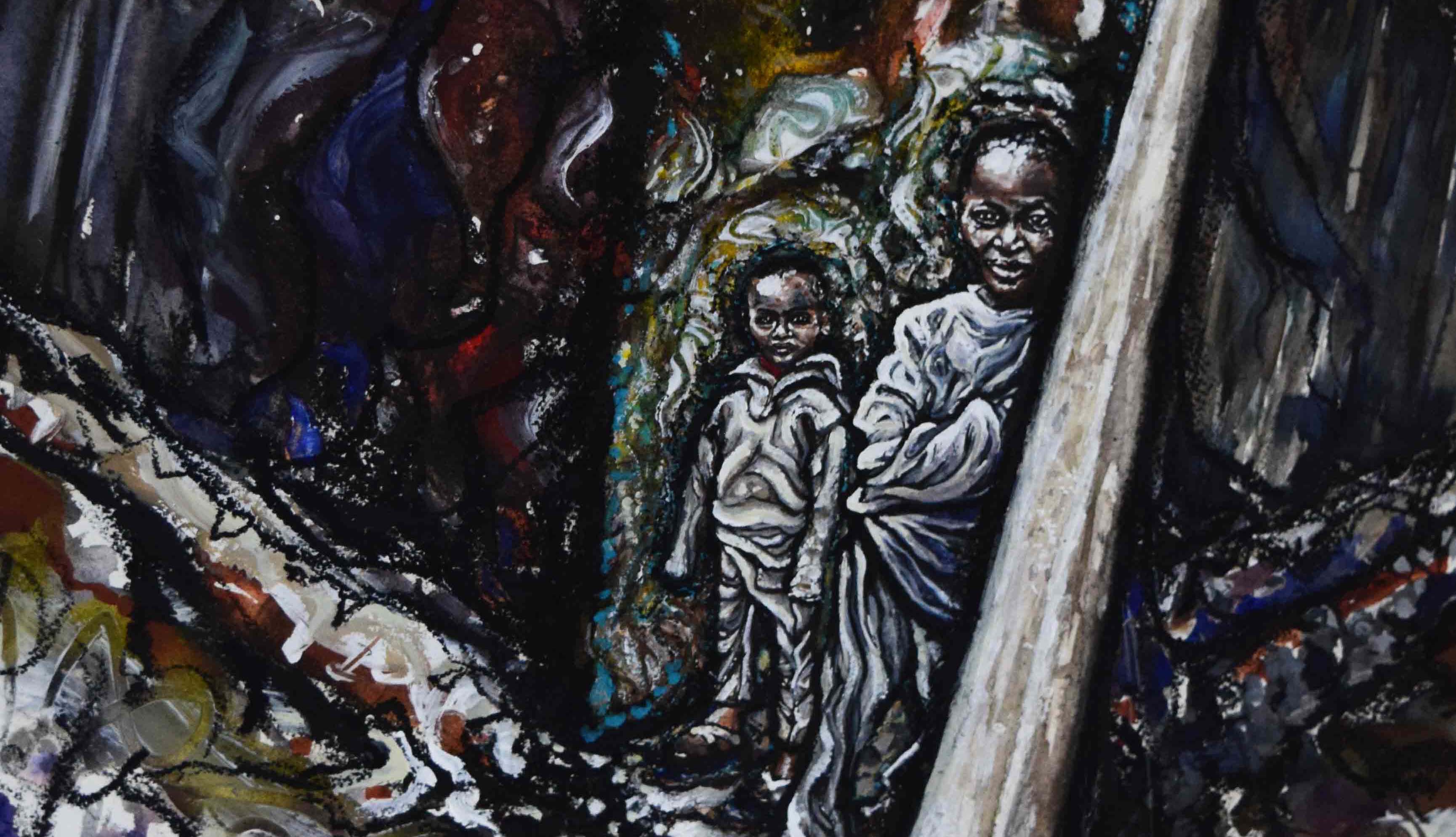
Beatitudes
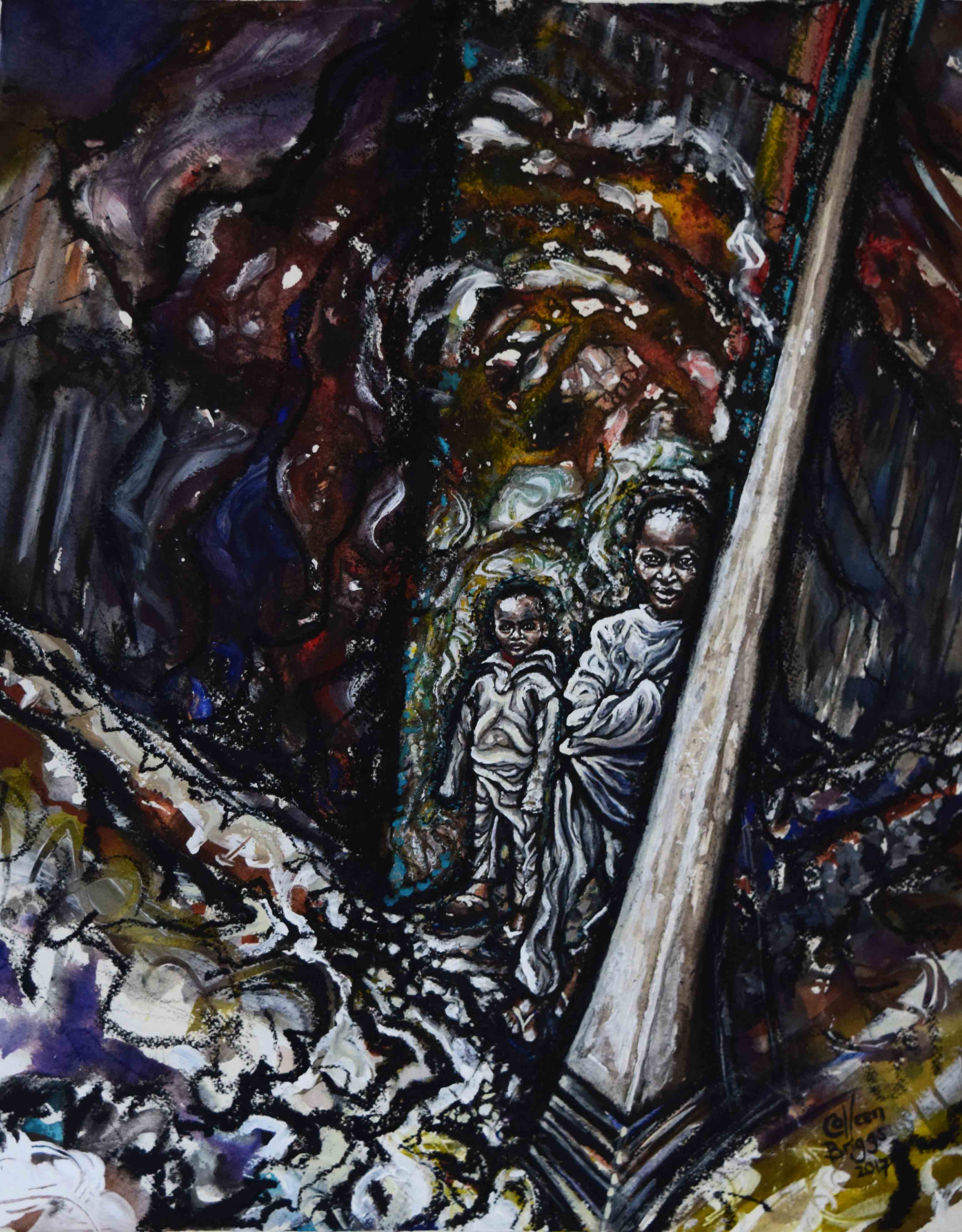
Blessed are the poor in spirit, for theirs is the Kingdom of Heaven (Matthew 5:3)
Skin and bones hover on the bed in an uneasy truce between life and death; neither dominating for the time being. Waking or sleeping, *Sarah has not left the confines of her bed, much less this 10’ x 10’ shack, for three weeks.
I, along with a few American friends, crowd into the compact, murky space. *Rose sits on the bed next to Sarah. Lifelong friends, Rose aspired in her childhood to emulate Sarah, who consistently ranked number one academically. But, as they grew in the impoverished desperation of East Africa’s second largest slum of Mathare Valley, Sarah contracted HIV.
Rose, however, escaped Mathare. Now she returns as a volunteer counselor for the Mathare Worship Center VCT (Voluntary Counseling & Testing) HIV clinic. After serving at the church during the day, she buys food at a nearby market for Sarah with the money given to her as a volunteer to pay for transport home. She walks the muddy labyrinth of paths deep into the slum to the bedside of her old friend. Rose bathes Sarah, tends to her bed sores, helps her eat, gives her the clothes off her back. Then she walks nine miles home.
I stand in the door frame of Sarah’s dim, iron sheet shack, propping the door open with my foot. Rose supports Sarah into a sitting position, lifting a cup of fresh mango juice to her lips. Equatorial light filters through the doorway, bathing the sharp angles of Sarah’s face in a golden glow.
In the shadows, my friends begin to sing. Their voices blend and soar, battling unfathomable suffering and hopelessness with ethereal harmony. Tears pound behind my eyes, then stream down my face. “How deep the Father’s love for us, how vast beyond all measure…” (How Deep the Fathers Love for Us by Stuart Townend).
A tangible sweetness swells, as if the King Himself sweeps in to hold Sarah. As if the very Kingdom of God invades the room.
Sarah’s gaze locks on mine as the women bridge to Jesus Loves Me. Looking straight into her eyes, I change the last word to “you.” “Jesus loves you.” Her eyes shine. She’s seeing something I can’t yet. My throat thickens and I can only mouth the words, “Jesus loves you.”
I want to linger here forever. But Sophia is weary.
Rose lowers her to the bed, tucks her in tenderly. Quietly we slip back into the harsh light, the stinging fumes, the colossal conundrum of Mathare Valley.
As humans, we try to avoid poverty of any kind. We fear the moment when all earthly resources have been expended, when we lay powerless, exposed, vulnerable, at the mercy of whatever comes against us.
In America, we often default to thinking of poverty as a physical condition. But those who minister to the poorest of the poor describe a much broader concept. Dr Brian Fikkert, in his book When Helping Hurts and a video series based on the book (available on youtube), defines poverty as the result of four broken relationships:
- with God – when we place our security, trust and belief in anything but God, our relationship with God is broken;
- with others – when we believe we are in control and provide our own security, or, on the flip side, wrestle with low self-esteem, our relationship with ourself is broken;
- with ourselves – when we exploit or abuse others or struggle with self-centeredness, our relationship with others is broken;
- with creation – when we experience loss of purpose, steward resources poorly, or work too much or too little, our relationship with creation is broken.
By this definition, we are all poor in one way or another. To be human is to experience broken relationships. Physical poverty only serves as a tangible manifestation of the poverty of spirit that is common to humankind. If we are brave enough to admit it. That’s the bad news. But the good news is that Jesus promises us in the first beatitude that poverty of spirit is the gateway to the Kingdom of God.
For those of us who resist admitting our innate poverty of spirit, consider the example of Jesus. In Matthew 3, John the Baptist, a very strange man who wore animal skins and operated on the fringes of society, baptizes people in the wilderness. He insists that repentance is the only entrance to the coming Kingdom of God. When the religious leaders of the day, who depend on their own outward appearance of righteousness, stream out to him, John calls them a “brood of vipers.” But then Jesus approaches, the only One who is truly righteous, and asks to be baptized. Shocked, John argues that Jesus should baptize him. However, Jesus, with no need to repent, submits to baptism as a statement from the beginning of his ministry that he identifies with us, with the broken humans he has come to redeem. In a rare manifestation of the trinity in one moment of time, the Father pronounces, “This is my beloved son” as the Spirit descends like a dove and alights on the Son.
If identification with us as broken and in need of repentances forms the launching pad for Jesus’ ministry, why are we so afraid to admit we don’t have what it takes?
To complete my story about the team whose tickets to Nairobi were deleted by the airline, my long hours of wrestling in prayer culminated in a message, sometime in the deep watches of the night, that eight of ten team members had been issued new tickets for the next day. I fell into exhausted slumber, not knowing if the last two, my son and daughter-in-law, would board the flight. I recognized my true poverty of spirit, my inability to do anything about the situation, placed it in the hands of God, and fell asleep. You can imagine my overflowing joy when at last all ten members of the team filtered out of customs in Nairobi.
On the team’s first full day in Kenya, Steve Kariithi, pastor of Mathare Worship Centre and Hope’s Promise Program Director, orients us concerning the origins of Mathare Valley, Nairobi’s oldest slum, a place of extreme physical poverty. After Kenya declared independence in 1969, people from rural areas replaced freedom fighters who had hidden in its trees, flowing into the city in search of a better life. They constructed cardboard homes in the valley with cardboard, eventually replaced by iron sheeting.
Today, in 2024, the half a million residents of Mathare Valley who live within its six square miles earn an average of $80/month by working as day laborers in jobs such as construction or house help for wealthier areas. Many, though, especially young men, turn to crime. Steve tells us about one of his best friends, *Jason, who grew up in Mathare Valley. By the time Jason was in his late twenties, 90% of his male friends had been gunned down in crime or by police.
Visuals from earlier in the day crowd our minds as Steve talks. We walked through the slum and turned down a narrow corridor laced with rusty metal, live electric wires, and neighbors peeking out from every nook and cranny. When we finally squeezed down to the opening to *Zoe’s house, only half the team could enter at a time. Now a grandmother, living in one room with daughters and granddaughters, Zoe first came to the valley as a young woman from a rural area in search of work. Her granddaughters, third generation residents of Mathare Valley, may never know anything different.
“Poverty,” Steve says, “reconfigures the brain.” Long term deprivation, far more than physical conditions, forges quick paths into broken relationships.
For example, while I don’t know Sarah’s story of how she contracted AIDS, I do know that preventing AIDS in impoverished areas is anything but simple. When breast milk infects babies, young girls contract HIV from men who believe the myth that having sex with a virgin will cure their own illness, and women of all ages prostitute themselves to feed their children or live in serial monogamous relationships with men who often get them pregnant and then leave, the roots of the illness remain extremely complex.
In the Old Testament, the Hebrew word Anawim describes the poor remnant of people who remained faithful to God in times of difficulty. In an interview with Christianity today, published on Dec. 1, 2002, Brennan Manning says, “Now, when the Anawim theme comes into the New Testament, the Anawim are those who gather to meet Jesus at his birth. They’re the poor ones, the nobodies, the people on the margin of respectability. They’re the shepherds. There’s Anna, this old lady at 84 years old. There’s Simeon, an old man. And all these animals. And then, of course, there’s the Virgin Mary, who was considered the last and lowliest in a long line. Those are the ones who are truly poor in spirit. They acknowledged their utter dependence on God even for their next breath, have just cast their lot with Jesus, and surrendered to the Father’s will.”
On earth, Sarah subsisted on the margins, oppressed by the horrific implications of broken relationships, and died not long after we visited her. But sometimes I wonder, who is poor? Me, self-sufficient and independent as I make my way in middle class America? Or Sarah, who knew the depths of relying on Jesus for everything until her last breath?
I wonder if it’s only when all earthly resources have been expended that we truly see beyond them and dare to hope, believe, even see, while we are still on earth, that there is something more? That we actually enter and inherit the Kingdom of heaven while still living on earth?
*Names changed for privacy
Reflection questions:
Why do we typically try to avoid poverty of any kind?
In what ways do you seek to alleviate your “poverty of spirit” besides Jesus?
How might admitting that we don’t have what it takes open us to resources we hadn’t experienced before?
Why do you think Jesus identifies “poverty of spirit” as the gateway into the Kingdom of God?
……………………………………………….
Subscribe to my bi-monthly e-newsletter for glimpses through images and writing of the God Who Is With us:
 Colleen Briggs Images & Writing
Colleen your descriptions bring back so many memories of Mathare Valley. And how perfectly the Beatitude “Blessed are the poor in spirit for theirs is the kingdom of God” is displayed if only we have eyes to see! Thanks for sharing!!
I loved this, Colleen. I love the way you bring us right into the moment – sharing your experience and then your wisdom and understanding to encourage us – thank you! Thank you so much. May God continue to use you as He does and far beyond the realms of familiarity that you may grow even more dependent upon Him as you recognize your own spiritual poverty. Be blessed! I give God thanks for your obedience.
Thank you so much for reading Desere, and for taking time to encourage me.